
FAQ
Frequently asked questions
Costs, registration, tryouts, codes of conduct — answered here. If you don't see your question, email annarboras@gmail.com.
Costs & registration
-
What are the total player fees for the season?
Player fees are $2500 for the 2026-2027 season. Financial aid and player sponsors can offset this cost substantially.
-
What is included in the cost?
Your player fee's cover fall practices, winter Indoor team practices, Small group practices, clinics, and a full spring/ summer schedule. This would be a league schedule with approximately 15 games and 3-4 tournaments. Players will also receive an A's helmet and an A's bat bag. Coaches may request families to fundraise to pay for additional tournaments, uniforms, or events. The tournament only team model requires additional fundraising.
-
Is financial aid available?
Yes. The A's organization has stated publicly that player fees should not be a factor in deciding whether or not to play for the A's.
Financial aid for player fees is granted in 25% of player fee increments. Aid can also be awarded to cover the cost of personal items not included in the player fee — for example, a bat, glove, or cleats.
See our Financial Aid page for more details.
-
What extra expenses are not included in the player fees?
Bats & gloves for the player, cleats, and some travel & lodging costs depending on the team. Uniforms
-
Are there payment plans or fundraising opportunities available?
Yes. Fees are separated into 4-5 equal payments monthly until the balance is paid. Customized payment plans can be made in certain situations. Players can utilize "player sponsors" to offset the cost of their player fees. 100% of any player sponsor will come off of the players' fee. Additional team fundraisers can wipe out the need to pay any additional funds.
Tryouts
-
When do the A's hold tryouts?
The A's typically hold tryouts in mid- to late July. Tryout scheduling is usually announced in late June/early July. Check the Tryouts page, or contact annarboras@gmail.com for more information.
-
What are Key Performance Indicators (KPIs) and why does the A's use them?
Key Performance Indicators (KPIs) are a set of physical and movement-based measurements the A's use to evaluate and develop players. Per the organization's own materials:
These measurables are key to drawing a connection between player movement patterns and the ability to throw or hit the ball as hard as possible. While these measurables take time to train and develop, many college and professional players that have trained these have seen exponential improvement over time.
The intent is two-fold:
- Diagnostic — identify movement patterns that limit a player's ability to throw and hit hard, so the player and coach know what to work on.
- Developmental — give each player a personal baseline that can be re-measured over time, so progress is visible.
KPI testing is typically run in the fall. Specific measurements that make up the current test battery are confirmed by the coaching staff each year and shared with families.
Playing for the A's
-
Tourney only vs League and tournaments?
Tournament only teams build the bulk of their schedule through tournament competition. These are weekends with 3 or more games played. These typically last from Friday through Sunday. Some tournaments may begin on different days of the week, however, these are rare. Tournament only teams will typically play 8-10 tournaments between the fall, winter, and summer. League plus tournament teams will play a league schedule of approximately 15 games. These games are typically held on weeknights, across Southeast Michigan.
-
How far do we have to travel?
Most league games are within 45 minutes of travel with a 6 or 630PM start time during the week.
Tournaments are mostly local, within an hour of Ann Arbor.
For 8U and 9U there are typically no overnight tournaments. For 10-11-12U teams may choose to do 1-2 overnight tournaments usually within 3-4 hours.
For 13-16U there may be 3-4 overnight tournaments with the possibility of one of them being 4-5 days at a destination such as Pigeon Forge, Myrtle Beach.
-
What does the weekly practice schedule look like?
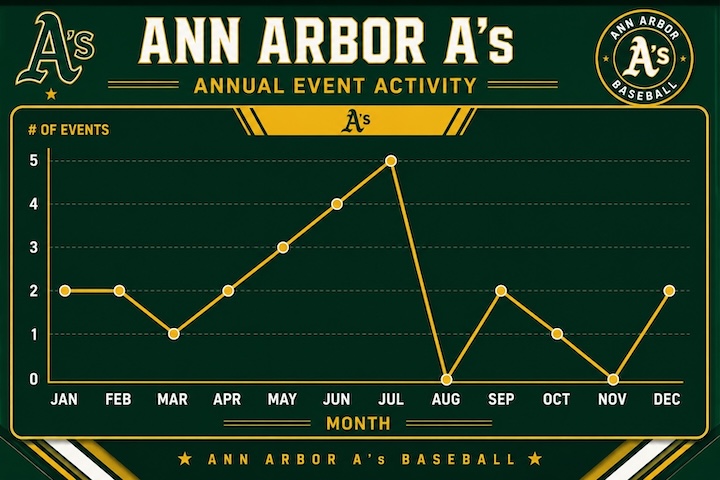
Season Months Practices per week Fall September - October 2 practices/week Winter December - January 2 practices/week Spring February - April 2 practices/week "Prime" Season (Spring/Summer) April - July 1 -2 practices/week - During "Prime" Season, we expect baseball to take priority over other sports. We do hold high value in building the "athlete first" so we encourage our players to plan as many sports as possible during fall and winter even if that means they miss baseball due to conflicts.
- During "Prime" Season we expect there to be 3-4 baseball events per week between midweek games and practices and tournaments. On some occasion there may be 5 baseball events in a given week.
-
Does the season run year-round or just during spring/summer?
The season is not year-round. Weekly activity ramps up in Prime season (Spring/Summer), peaking in late June/early July. There are large breaks in July-August, November, and January.
-
What does the off season look like?
The typical off season looks like 2-3 opportunities to practice each week from September through October. We will extend the fall if the weather cooperates. Once the weather turns for the worse we will move indoors to South State sports our indoor facility. The A's hold optional hitting clinics in December run by paid professional coaches. January through March is considered our pre-season build up phase. This includes clinics hosted by current college players, former pros, and our in house staff at South State. In addition to hitting, fielding, and catching clinics; your coach will host a weekly team practice and small group practices. In total it equals about 2-3 opportunities to practice each week during the winter. These are all included in your player fees. Additional lessons in pitching, catching, batting are also available for extra cost.
-
Is the offseason mandatory? What if my child plays another sport?
We call these opportunities, as these are not mandatory offseason practices. We encourage the players to be there, but they will not be punished for missing. We appreciate our multi-sport athletes as they make up the majority of our player base. Of course, the more you attend, the more practice you get and the more likely you are to earn playing time.
-
Who will coach the team, and what are their qualifications?
Some are paid coaches and some are volunteers. Qualifications range from former professional players to volunteers who are trained to implement the A’s player development strategy. The A's organization has annual coaches meetings to ensure the development of every player at every age. We want to make sure we are teaching skills and drills that are appropriate to each age group.
-
What is the organization’s philosophy on playing time?
The A’s focus on player development and a big part of player development is getting live playing time. Playing time can be affected by missing mandatory practices & events or violations of the A’s Code of Conduct. Nobody will be sitting entire games. Typically a player may sit 1-2 innings depending on roster size. We will bat a full lineup not only in pool play but in bracket play as well until the 14U age group. Even at the older ages, many times, the full lineup will bat.
-
What off-season development programs do you provide?
In November, every player is tested on baseball specific objective measurables such as throwing speed, hitting speed. In addition, we will test every player's "Horsepower" which is a combination of a player's vertical jump, and 2 medicine ball tests. This gives us a look into where the improvement needs to happen. This can be tracked and retested throughout the winter to ensure each player is getting better. We do test annually to track development over time.
-
How many players are carried on each roster?
Minimum 10 players/team. Maximum 13/team. However, this up to the coaches discretion and is based on team needs.
-
What bat should I purchase for my child?
Every child has different needs from a bat. There is no one size fits all answer for bats. For the A's we suggest using a USSSA or 1.15BPF stamped bat. Travel baseball uses these stamps to certify the eligibility of the bat for us. Bats without a stamp are illegal in league and tournament play. Bats not stamped with USSSA or 1.15BPF will have a reduced effectiveness as other approving agencies require bats to not trampoline a ball as fast off of them. In general 8-10U players will swing a "-10" bat. 11-12/13 will swing a "-8" bat and 13-14 will swing a "-5". 14U+ will swing a -3.
Code of conduct
-
What is the Player Code of Conduct?
Every A's player is expected to sign and abide by the AAATB Player's Code of Conduct. It opens with the principle that "it is a privilege to play on a travel baseball team," and asks each player to commit to nine things:
- Play the game for the game's sake, not just to please parents or coach.
- Be modest and generous when winning, and gracious when losing.
- Respect the game and its rules — learn them, try to follow them, play fairly.
- Work for the good of the team and give best effort at all times.
- Show respect for the authority of umpires, even when disagreeing with a call.
- Show good sportsmanship before, during, and after games — opponents are opponents, not enemies.
- Conduct yourself with honor and dignity, and treat other players as you'd like to be treated.
- Help parents and fans understand the rules so they can watch and enjoy the game — and understand that public dissent is not permitted.
- Control your temper and don't retaliate, even when you believe you've been wronged.
The complete form is available as a PDF: AAATB Player's Code of Conduct Form.
-
What is the Parent / Guardian Code of Conduct?
Every parent or legal guardian of an A's player signs the AAATB Parent/Legal Guardian Code of Conduct Agreement, which asks for the following eight commitments:
- Promote the emotional and physical well-being of the player ahead of any personal desire to win.
- Remember the player plays baseball for their enjoyment, not the parent's.
- Encourage good sportsmanship by demonstrating positive support for all players.
- Support the coaches and officials — leave the coaching to the coach during the game, and don't give instructions from the sideline.
- Demand that the player treat all players, coaches, officials, parents, and spectators with respect.
- Treat all players, coaches, officials, parents, and spectators with dignity and respect in language, attitude, behavior, and mannerisms.
- Cheer within the spirit of fair play — cheer effort regardless of outcome.
- Make sure the player is on-time and prepared for every game and practice.
Conduct subject to discipline
The agreement also lists examples of conduct that violates the Code, including (non-exhaustively):
- Making physical contact with any player, coach, official, league representative, field personnel, or spectator.
- Taunting or threatening any of the above.
- Entering the dugout of an opposing team, or obstructing access to or exit from a dugout.
- Entering the umpires' area, or obstructing their access to or exit from the field.
- Using profane or vulgar language or mannerisms.
- Entering the baseball field.
- Throwing any object onto the field, into the player area(s), or at another individual.
- Defacing or damaging property.
- Activity that would warrant the summoning of law enforcement officials.
- Inciting any person(s) to engage in the above.
- Any other conduct not in compliance with the tenets of AAATB and its affiliate member organizations.
The agreement states explicitly that failure to comply with the Code, or participation in any of the listed Conduct Subject to Discipline, may result in disciplinary action up to and including expulsion from Ann Arbor A's Travel Baseball and its affiliate member associations.
The complete form is available as a PDF: AAATB Parent/Legal Guardian Code of Conduct Form.